Published July 5, 2026
How to Keep Homeschool Records Without Feeling Overwhelmed
8 minute read
In this article
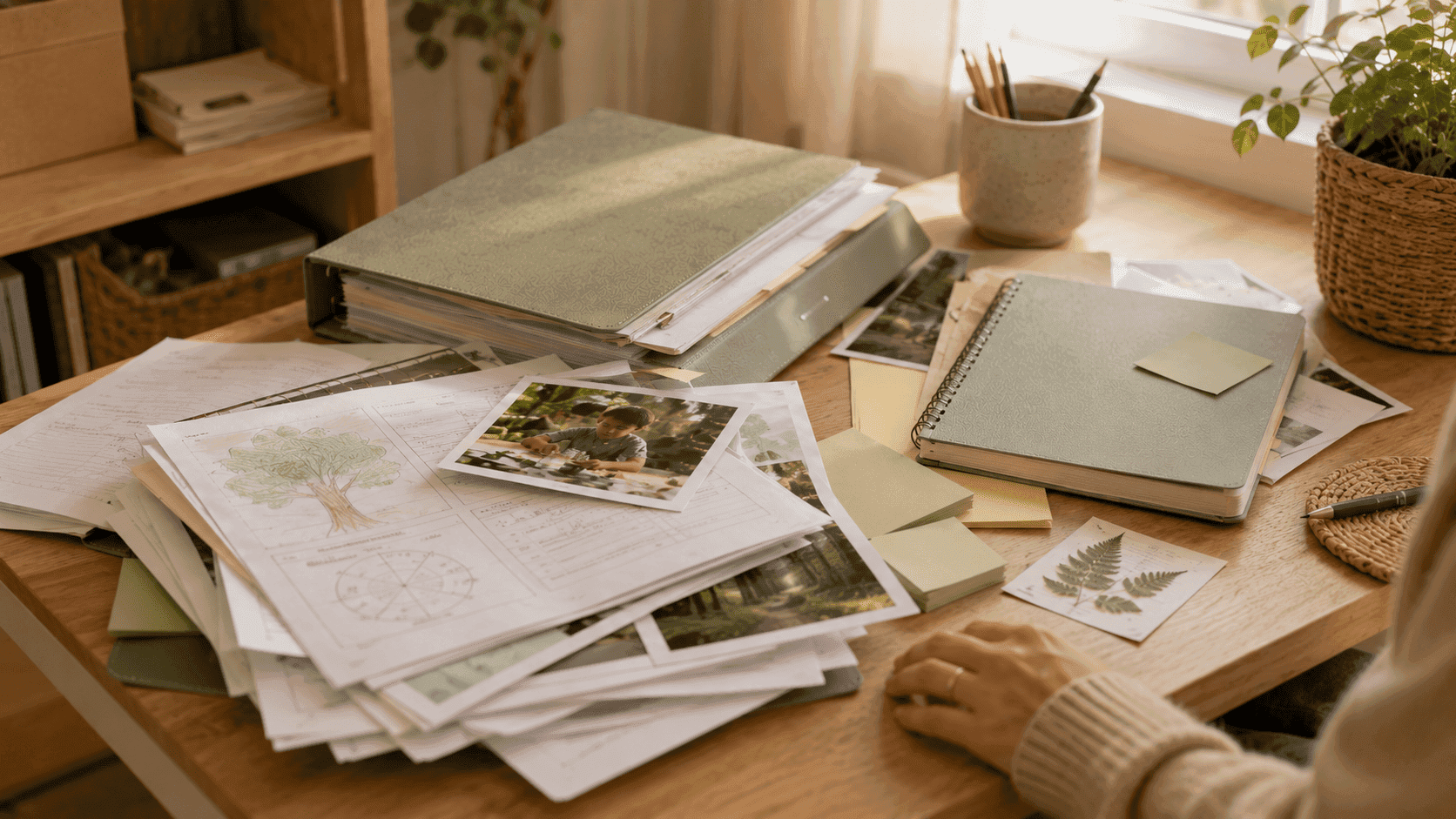
Portfolio time arrives, and suddenly the year feels scattered. There are photos on your phone, worksheets in a folder, book reports in a box, notes in a planner, a few files in Google Drive, and a field trip you know mattered but cannot quite explain months later.
If that sounds familiar, you are not behind. Many homeschool parents are already doing the learning. The hard part is keeping enough context so the learning is easy to remember later.
Homeschool record keeping does not have to mean saving everything or building a perfect system. A calmer approach is to capture small moments as they happen, keep enough context, and organize later when you actually need to review the year.
The real problem is not homeschooling
Most parents are not overwhelmed because they are failing to homeschool. They are overwhelmed because their records live in too many places.
A science activity may be in the camera roll. A reading note may be in a notebook. A math worksheet may be in a binder. A project photo may be in a text message. A curriculum platform may store some records automatically, while physical tests and quizzes sit in a storage box.
Each piece makes sense on its own. The stress comes later, when you try to turn all of it into a clear picture of the year. That is why good homeschool record keeping is less about creating a perfect archive and more about making the important moments easy to find again.
What homeschool parents keep telling us
What homeschool parents keep telling us
Several homeschool parents have described the same pattern: they capture learning throughout the year, but only organize everything later when they need records or a portfolio.
“The capture happens continuously, but the curation happens later.”
That distinction matters. A good homeschool record-keeping system should make everyday capture easy, then help parents review and organize later.
Keep records as you go, not all at once
The easiest homeschool records are usually captured while the learning is still fresh. That does not mean stopping the day to complete a long form. It can be as simple as saving one photo, writing one sentence, or putting a worksheet in the right folder.
Think of record keeping as a light habit, not a separate project. You are not building the whole portfolio every day. You are preserving enough small pieces so portfolio time is easier later.
This is the “capture now, curate later” approach. During the year, capture what happened. Later, when you need a portfolio or review, choose the records that best represent your child’s learning.
What should you keep?
You do not need to keep every paper, every photo, or every note. Start with records that help you remember what your child did, practiced, made, read, solved, or discussed.
- Photos of projects, nature study, field trips, experiments, art, or life skills.
- Worksheets that show practice, progress, or a representative piece of work.
- Projects, book reports, tests, quizzes, or creative materials when they matter for your family.
- Reading notes, book lists, narrations, or short reflections.
- Field trip notes with the place, date, and what your child noticed.
- Short notes about conversations, documentaries, games, cooking, building, or hands-on activities.
If you are unsure whether something counts, this guide to what counts as homeschool evidence gives more examples.
If your homeschool is mostly project-based or hands-on, this guide to documenting hands-on learning without worksheets may be especially helpful.
Add simple context
A photo is much more useful later when it has a little context. Without context, you may remember that the activity was meaningful, but not what subject it connected to or what your child practiced.
You do not need a long write-up. For many records, five small details are enough:
- Date: when it happened.
- Child: who the record belongs to, especially if you have more than one child.
- Subject: the main learning area, such as science, reading, math, history, art, or life skills.
- One-sentence note: what happened in plain language.
- Why it mattered: the skill, progress, question, or meaningful moment you do not want to forget.
For example: “June 12 — Maya planted bean seeds, measured the sprout, and noticed how the leaves changed after watering.” That one sentence can turn an ordinary photo into a useful homeschool record.
Use the system you already have
You do not have to throw away your binder, planner, Google Drive folders, curriculum platform, storage boxes, or camera roll. A good record system should support how your family already homeschools, not force you into a whole new method.
If your family is paper-first, keep using the binder or storage box. If your curriculum platform saves tests or quizzes, let it do that job. If your best records are photos, create a simple habit for adding context before the memory fades.
The goal is not one perfect tool. The goal is a system you can keep using. This comparison of binders, spreadsheets, Google Drive, and apps can help you decide what each option is best at.
Do not keep everything
One of the biggest reasons homeschool record keeping feels heavy is the quiet belief that you need to save everything. You do not.
Most portfolios and year-end reviews are easier to understand when they show representative records: a few meaningful samples from throughout the year, not a pile of every worksheet and every photo.
A useful record might show progress, effort, a new skill, a subject connection, or a moment that would be hard to remember later. Enough meaningful evidence is better than perfect documentation. If this is the part that makes you nervous, read how much homeschool evidence is enough.
What not to do
This is not a list of mistakes to feel bad about. It is a gentle reminder that homeschool record keeping works better when it is small, steady, and realistic.
- Don’t wait until the end of the year to remember everything.
- Don’t feel like you need to save every worksheet.
- Don’t force yourself into a completely new system if your current one mostly works.
Capture now. Organize later.
If record keeping feels too big, shrink it into a simple rhythm:
Learning happens
Natural learning every day.
Capture the moment
Take a photo or save a worksheet.
Add one sentence
Add a little context while it’s fresh.
Keep it in your current system
Binder, planner, Google Drive, or wherever you already keep records.
Review later
No need to organize everything immediately.
Build your portfolio
Choose the moments that best tell your child’s learning story.
The rhythm is simple on purpose. You are not trying to make every moment portfolio-ready immediately. You are keeping enough context so the right records are easy to recognize later.
A simple weekly habit
A weekly habit can prevent the end-of-year scramble. Set aside 10–15 minutes once a week to gather the loose ends.
- Move a few important photos into a homeschool folder.
- Add one sentence to the photos you know you may want later.
- Put physical worksheets, tests, quizzes, or projects in one place.
- Write down one reading, field trip, project, or hands-on moment from the week.
- Mark anything that may become a portfolio sample later.
The point is not to review the whole week perfectly. It is to keep the small memories from disappearing. Ten quiet minutes now can save hours of guessing later.
When portfolio time comes
Portfolio time should be a review process, not a reconstruction project. If you have captured small records throughout the year, you can look back, notice patterns, and choose the samples that best show your child’s learning.
That is very different from scrolling through months of photos and trying to remember what happened. Instead of asking, “What did we do this year?” you can ask, “Which records tell the story best?”
To see what organized homeschool records can look like, view the free Sample Portfolio. It uses Florida as one concrete example, but the basic workflow of capturing learning and curating later can help many homeschool families.
Final thought
Editor’s note: This article is based on ongoing conversations with homeschool families in the U.S., Australia, Canada, and beyond. As we keep learning from parents, we’ll continue improving our guidance to reflect real homeschool workflows.
Homeschool record keeping does not need to become another subject you teach or another system you have to maintain perfectly. Start small. Capture the moments that matter. Add enough context that you can understand them later. Keep using the systems that already work for your family.
Homeschool Keeper is being built around that idea: support the way families already homeschool, preserve learning moments as they happen, and make portfolio season feel more like review than reconstruction.
Related articles
Want to see what organized homeschool records could look like?
The free Sample Portfolio shows how scattered learning moments can become one organized homeschool portfolio.
If you are still getting oriented, the Record Keeping Guide is a helpful place to continue.