Published July 5, 2026
How to Organize Homeschool Photos Without Losing Important Memories
8 minute read
In this article
You open your phone and discover 5,000 photos. Somewhere inside are science experiments, baking projects, museum visits, nature walks, reading moments, art projects, and the little everyday pieces of homeschool life that felt meaningful at the time.
But when portfolio time arrives, the photos all start to blur together. Which photo was the plant observation? Was that grocery trip math, life skills, or both? What book was your child reading in that picture? Why did you take seven photos of the same worksheet?
Your phone is not the problem. The problem is trying to remember months later why each photo mattered.
Homeschool photos can be one of the easiest ways to preserve learning. They can also become one of the hardest things to use later if they stay buried in a camera roll with no context. This guide is about organizing homeschool photos simply, without building a complicated system or saving every picture forever.
Photos are memories, not records
A photo is a memory first. It shows that something happened, but it does not always explain what happened.
Months later, a photo alone rarely tells you the date, the subject, the skill practiced, the book or material used, or why the moment mattered. You may remember that the activity was important, but not the details that would make it useful as a homeschool record.
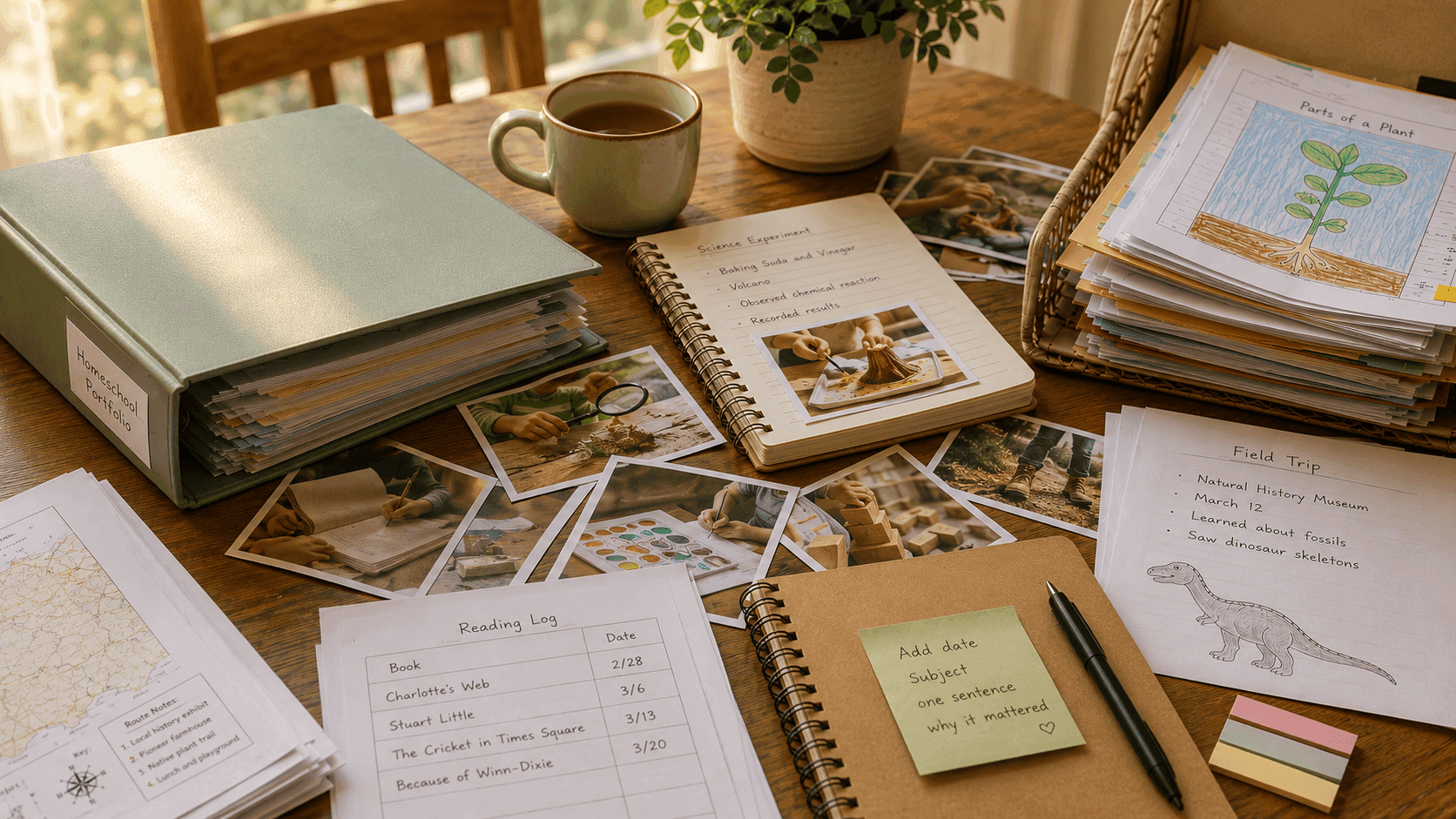
That is why homeschool photos become much more useful when they include a small amount of context. A photo of a child holding a measuring cup might be baking, fractions, following directions, reading a recipe, kitchen safety, or all of those at once. A photo of a nature walk might connect to science, observation, writing, art, or geography.
You do not need to turn every photo into a report. You only need enough context so future-you can understand why the photo was worth saving.
What homeschool photos are worth keeping?
The best homeschool photos are usually representative. They show a meaningful learning moment, a skill in progress, a finished project, or something that would be hard to remember later.
You do not need photos of everything. You do not need twenty versions of the same worksheet or every angle of the same art project. A few meaningful moments each week usually tell the story better than hundreds of nearly identical photos. Choose the pictures that help tell the learning story.
Science experiments
A setup, observation, result, or child explaining what changed.
Art and creative projects
Finished work, process photos, or materials your child used.
Reading
A book stack, reading journal, narration note, or cozy read-aloud moment.
Writing
A sample page, journal entry, report, caption, or before-and-after progress.
Field trips
Museums, nature centers, library events, historical sites, or local outings.
Outdoor learning
Nature walks, gardening, weather observations, maps, rocks, insects, or plants.
Building and making
Blocks, models, robotics, crafts, tools, experiments, or problem-solving projects.
Everyday learning
Cooking, budgeting, music practice, life skills, chores, repairs, or conversations.
If you are wondering whether a photo can count as homeschool evidence, it may help to read what counts as homeschool evidence. The short version: photos can be useful when they show learning, progress, context, or a meaningful activity.
Add one sentence while the memory is fresh
The simplest way to organize homeschool photos is not a complex folder system. It is one sentence.
One sentence turns a vague image into a useful record. Compare these two versions:
Hard to use later
IMG_4829.jpg
Useful homeschool record
March 18 · Science · Growing bean plants · Measured growth over two weeks and recorded observations.
The photo did not change. The meaning did. Now the picture has a date, subject, activity, and a simple explanation of what your child practiced.
This is especially helpful for hands-on homeschool learning, where the learning may not leave a worksheet behind.
A simple photo organization system
The best photo system is the one you can actually keep using. For most families, that means fewer folders, not more.
Start with one homeschool folder or album for the year. Inside that, use a few broad categories:
2026
- • Science
- • Reading
- • Projects
- • Field Trips
- • Everyday Learning
That is enough for many families. You can always add more later if you need it, but starting with ten or twenty folders often creates more decisions than clarity.
If your family already uses binders, Google Drive, a planner, a curriculum platform, or storage boxes, keep using them. This is not about replacing your system. It is about making your photos easier to find and understand when you need them. If you are comparing options, this guide to binders, spreadsheets, Google Drive, and apps can help you decide what each system does best.
Five common homeschool photo mistakes
These are not failures. They are just the small habits that make homeschool photos harder to use later.
- Keeping every photo: save the best representative moments, not every duplicate.
- Adding no context: a photo without a date, subject, or note can lose meaning quickly.
- Waiting until portfolio season: months later, the small details are much harder to remember.
- Saving blurry worksheets: if the text matters, take one clear photo straight-on in good light.
- Taking lots of duplicate photos: choose one or two strong images before they multiply into clutter.
The goal is not a perfect camera roll. The goal is a small set of useful homeschool photos that future-you can understand without guessing.
A five-minute weekly habit
Homeschool photo organization gets much easier when it happens in tiny passes. Once a week, take five minutes and do this:
- 1Open the week’s photos.
- 2Delete obvious duplicates and blurry extras.
- 3Choose two or three learning photos worth keeping.
- 4Add one sentence of context to each important photo.
- 5Move them into a simple homeschool folder or album.
Done. No elaborate archive. No long session. No guilt-scrolling through thousands of pictures at the end of the year.
If you want the broader record-keeping framework around this habit, read how to keep homeschool records without feeling overwhelmed.
When portfolio time comes
At portfolio time, organized photos should help you review the year, not rebuild it from memory.
Instead of scrolling through every picture on your phone, you can open the year’s homeschool album, skim the strongest moments, and choose the photos that best represent your child’s learning.
A good photo record might show a science activity, a field trip, a creative project, a hands-on math moment, a reading habit, or a piece of work that shows progress. You can pair the photo with a short note, date, subject, and skill connection, then decide whether it belongs in the portfolio.
To see what organized homeschool records can look like, view the free Sample Portfolio. It shows how everyday learning moments can become a clean, organized portfolio example.
Final thoughts
Photos are one of the easiest ways to preserve homeschool learning because they fit naturally into real life. You already take them during projects, outings, reading moments, kitchen math, nature walks, and ordinary days.
The goal is not to build the perfect archive. The goal is to help future-you remember what happened.
Homeschool Keeper is being built around that idea: capture learning naturally, keep the meaning with the record, and make portfolio season feel calmer later.
Related articles
Want to see what organized homeschool photos can become?
The free Sample Portfolio shows how photos, notes, worksheets, and hands-on learning moments can become portfolio-ready records.
If you are still getting oriented, the Record Keeping Guide is a helpful place to continue.